
Lipcamans turn matriarch’s love of quilting into bold landscape feature
PROTECTED CONTENT
If you’re a current subscriber, log in below. If you would like to subscribe, please click the subscribe tab above.
Username and Password Help
Please enter your email and we will send you a password reset link.
By DAVID CAMPHOUSE
David Camphouse/Pike Press
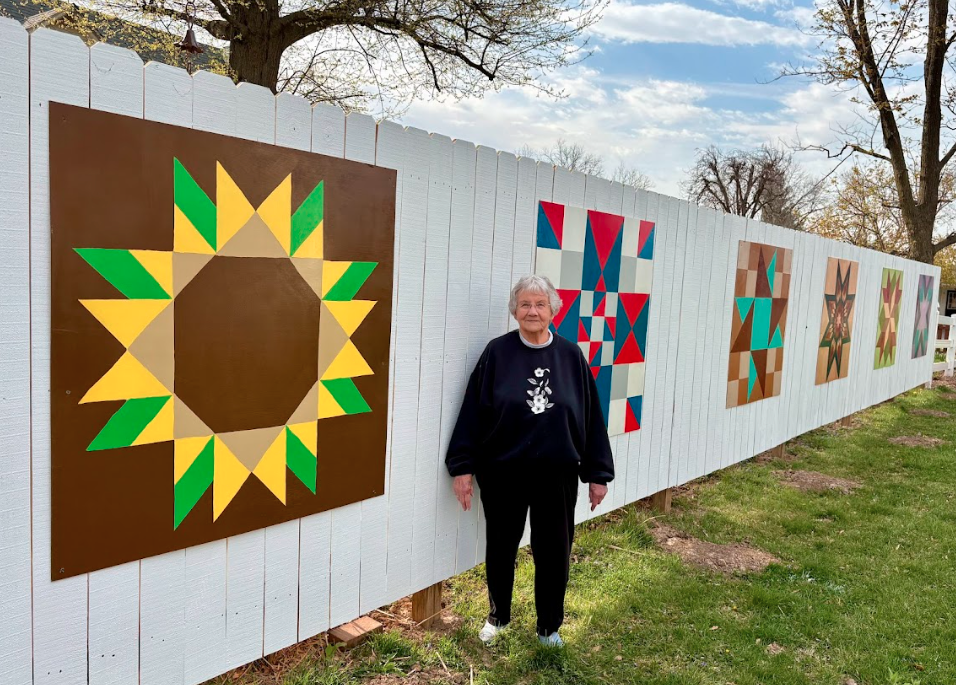
Mary Lou Lipcaman’s children and grandchildren decided to celebrate her love of quilting and history by creating a unique and lasting Christmas gift this year. The family created a privacy fence on the east side of Mary Lou’s yard, located along North Federal Street in Perry. To make the fence more unique and personal to Mary Lou, the Lipcaman children and grandchildren adorned the fence with six large painted “barn quilt” designs. To give the fence special meaning to Mary Lou, Sarah asked each of her grown children and her brother-in-law Mark’s family to each paint one barn quilt block on the fence.
Mary Lou Lipcaman’s children and grandchildren decided to celebrate her love of quilting and history by creating a unique and lasting Christmas gift this year.
The family created a privacy fence on the east side of Mary Lou’s yard, located along North Federal Street in Perry. To make the fence more unique and personal to Mary Lou, the Lipcaman children and grandchildren adorned the fence with six large painted “barn quilt” designs.
According to Sarah Lipcaman, Mary Lou’s daughter-in-law, the idea for the fence was inspired after she and Mary Lou saw photos of a similar fence.
“Mary Lou and I both saw a picture of a privacy fence with quilt blocks on it,” Sarah said. “Her face just lit up, and she was so excited about it. I knew right then that I was going to make it happen – ‘this has to happen’ I said.”
To give the fence special meaning to Mary Lou, Sarah asked each of her grown children and her brother-in-law Mark’s family to each paint one barn quilt block on the fence.
“I suggested that each of the families create and paint a design for the fence,” Sarah said. “We just made it a family affair, which meant a lot to her. We just thought it would mean more if the whole family took part in it.”
Mary Lou said that she took up quilting several decades ago, after her sister introduced her to the craft.
“I made my first quilt, which I still have, about 40 years ago,” Lipcaman said. “My sister got me hooked on it. At that time, my husband was still farming, so it took me several years to finish that first one, because I was busy.”
Lipcaman said commitment to quilting grew after the passing of her husband Gary “Bud” Lipcaman.
“After my husband passed, I started working, but I thought to myself I need something else to do with my time,” Lipcaman said.
Since she started quilting, many of the quilts Lipcaman created were for members of her family.
“I made wedding quilts for each of my grandchildren,” Lipcaman said. “And each family has gotten one baby quilt, because there are so many great-grandchildren I couldn’t make enough quilts for all of them. Aaron and Annette are the only ones that got two, because they had twins.”
According to Lipcaman, the barn quilt motif is popular with quilters across the country, and barn quilts have important historical significance as well.
Submitted photo
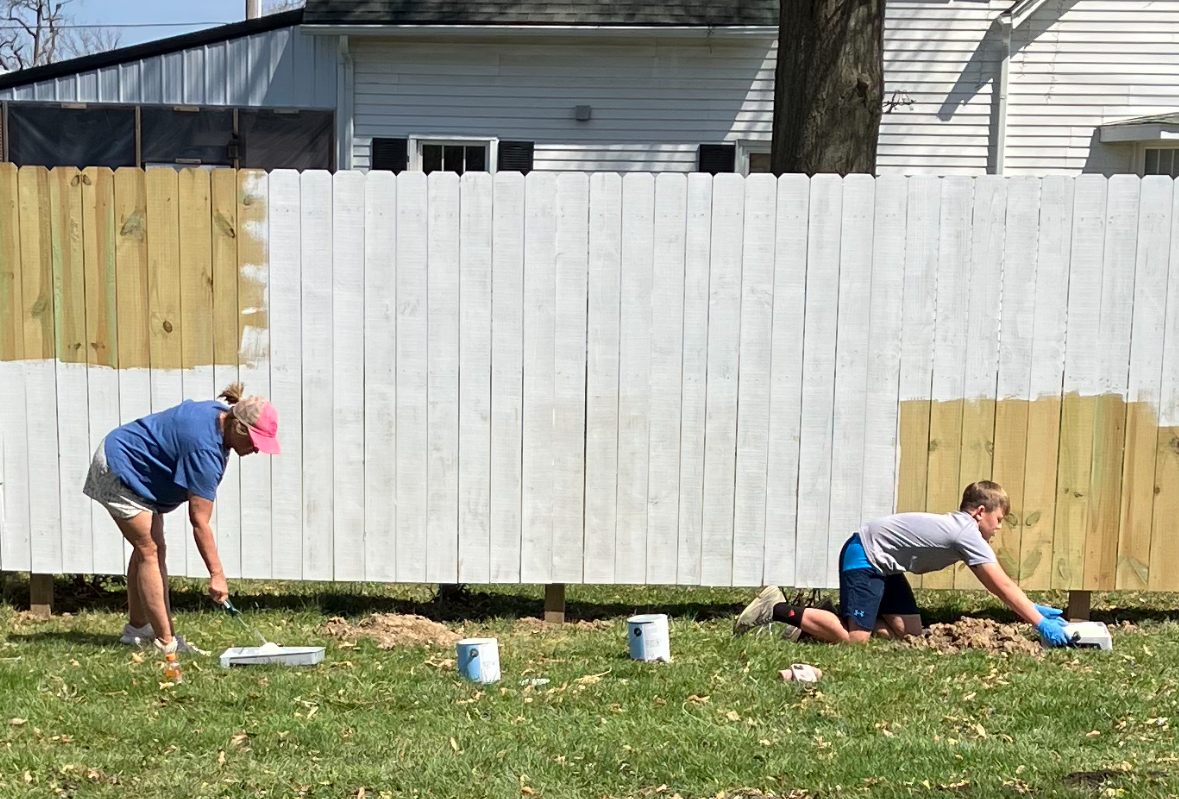
Sarah Lipcaman and her grandson Kase Lipcaman work to prime a privacy fence in the yard of Perry’s Mary Lou Lipcaman. The fence is adorned with six large, boldly-colored “barn quilt” blocks. Each block was designed and painted by the families of Mary Lou’s children and grandchildren. The fence is visible when passers-by are entering or exiting Perry on North Federal Street.
“They hung barn quilts as markers when they had the underground railroad,” Lipcaman said. “That’s how they got started. Since that time, quilters around the country have become interested in them. Barn quilts are just a neat thing – very decorative and unique.”
According to the Smithsonian Center for Folklife & Cultural Heritage, safe houses along the Underground Railroad were often indicated by a quilt hanging from a clothesline or windowsill. These quilts were embedded with codes that held meaning to enslaved people seeking freedom.
Sarah Lipcaman said that the placement of the new barn-quilt fence is designed to be visible to Mary Lou from many vantage points.
“The way it’s placed, she can see it when she comes and sits on the deck,” Sarah said. “But she can see it from inside, too – from her living room chair and from the kitchen window when she’s in there.”
Mary Lou expressed pride in the fence’s visibility to passers-by and is pleased that it can be enjoyed by others besides just her.
“The way it’s put up, people can see it from their cars if they are coming into town or going out,” Lipcaman said.
So, when next passing through Perry, be on the lookout for Mary Lou Lipcaman’s bright new barn quilt fence.
For more information on the history of barn quilts in the Underground Railroad, visit folklife.si.edu/magazine/underground-railroad-quilt-codes.
