Winchester home to the Father of Modern Dentistry
PROTECTED CONTENT
If you’re a current subscriber, log in below. If you would like to subscribe, please click the subscribe tab above.
Username and Password Help
Please enter your email and we will send you a password reset link.
By Carmen Ensinger
Carmen Ensinger/Scott County Times
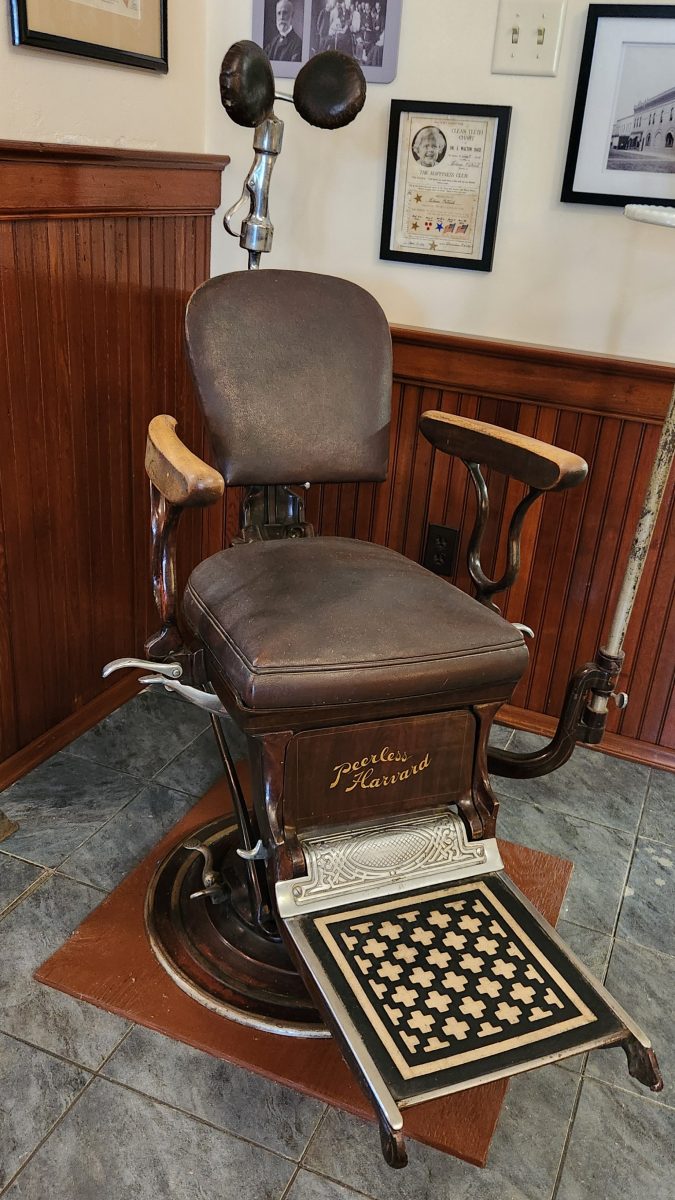
RIGHT: While Dr. Black might not have worked on any patients in this vintage dental chair, which is located in the Old School Museum, several other Winchester dentists did. This Peerless-Harvard dental chair sat above the First State Bank building on the northwest corner of the square. It may have been used by Dr. J. Walton Dace, who ran a practice in the front suite of the bank starting in 1896. Dr. Dace was known to always have the latest equipment. He brought the first x-ray to Winchester and even owned the first automobile in town. Another dentist, Dr. Warner E. Harper, had a dental practice on the second floor of the bank building between 1927 and into the 1950’s.
Some might call it ironic that Winchester’s Old School Museum is located in, wait for it, an old school house. But when one stops to think about it, it couldn’t be located in a better building.
A school house is known as an institution of learning and, for all intents and purposes, that is just what one does when one enters the door of the museum. Except there are not math classes or English classes, one learns about history, specifically the history of Winchester and Scott County.
For example, not many people know that in the mid 1850’s a Winchester native would open a dental practice in Winchester and eventually become known as the Father of Modern Dentistry.
His name was Greene Vardiman Black and he was born Aug. 3, 1836 at his family’s farm near Winchester. In his youth, he preferred observing nature instead of attending school or faring and developed an analytical mind that would serve him well in life.
At the age of 17, he began studying medicine from his brother, Thomas G. Black, a physician in Clayton. After four years of studying medicine, a chance meeting with a dentist, Dr. J.C. Speer, led him to become a dental apprentice and within several weeks he had felt he had learned everything he could from this dentist.
In 1857, at the age of only 21, Dr. Black opened a practice in Winchester, the first the town ever had. It should be noted that at this time, dentists were often self-educated. There were only seven dentistry colleges in the entire United States.
Dr. Black often traveled to small communities in the area to perform dental work. During 1860 and 1861, he extracted 175 teeth and placed 215 fillings, as was documented in his ledger.
After serving in the Civil War, Dr. Black established a dental practice in Jacksonville and began teaching dentistry in St. Louis, Iowa City and Chicago.
Between 1881 to 1887, Dr. Black served as President of the State Board of Dental Examiners and in 1900, he became the President of the National Dental Association.
As a pioneer in dentistry, Dr. Black wrote definitive textbooks in dental anatomy. He also invented many dental instruments and process and studied microbiology and cellular pathology that led to a better understanding and treatment of gum disease.
Dr. Black’s perseverance and endurance in solving problems would help revolutionize modern dentistry, making him known as the “Father of Modern Dentistry.”
The Old School Museum is open from 10 a.m. to 4 p.m. on Friday and Saturday and from 1 p.m. to 4 p.m. on Sunday. There is no charge to go through the museum and groups are always welcome.