
CALHOUN: Chip-a-Canoe project taking shape at McCully
PROTECTED CONTENT
If you’re a current subscriber, log in below. If you would like to subscribe, please click the subscribe tab above.
Username and Password Help
Please enter your email and we will send you a password reset link.

People from all over have gathered at the McCully Heritage Project to take part in making a canoe out of stone-age hand tools. (Diane Brangenberg/Calhoun News-Herald)

The canoe is being made out of a 40 year old tulip poplar. (Diane Brangenberg/Calhoun News-Herald)
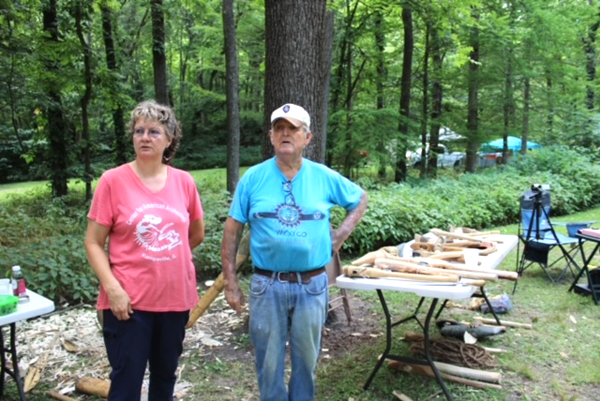
Board President Kathryn Chapman and Larry Kinsella explained the hypothesis as they observed the volunteers working. (Diane Brangenberg/Calhoun News-Herald)
By Diane Brangenberg
The McCully Heritage Project is currently hosting a project called Chip-a-Canoe. The objective of the project is to complete and document the construction of a dug out canoe using only stone-age hand tools.
The project is being led by Larry Kinsella, who got his start at the Center for American Archaeology in Kampsville. He was here from the beginning in the very first adult field school in 1972 and was on the Koster Site Dig. He›s had years of practice in experimental archeology of ground stone technology.
The purpose of the project is to test Larry’s hypothesis on how canoes were once built. Thinking that burning them out wasn’t the only way. He believes this is a misconception. If you›re going to burn it, it would have to be dry wood.
The tree is a 40 year old tulip poplar, which was cut down using only stone axes, adzes and celts, and was cut in Fairview Heights in early July before making its way to McCully.
Many people from all over the country have joined Kinsella in Kampsville to work on it with people coming from Iowa,Washington, Northern California, Arizona, Wisconsin, Virginia, Israel, Utah, Alton and Calhoun County.
Students from the Center for American Archeology Field School also worked on it.
“Once the bark is removed, approximately 1/3 of the wood will be removed from the top of the log. This will make the log much lighter to facilitate the turning of the canoe. Once the log is turned over, the outside of the canoe will be worked until completed. Then, the log will be flipped upright and the inside will be hollowed out to finish the canoe. We hope to set the canoe in one of the adjacent ponds to check out its efficiency. Then, we hope to float it in the Illinois River,” Kinsella said in an announcement about the project earlier this year.
There is really no way to guarantee how long it›s going to take to complete the project.
People attending the Archeology Days over the weekend enjoyed getting an opportunity to check out the one of a kind canoe.