
SCOTT: 124-acre solar facility planned south of Winchester; public hearing April 23
PROTECTED CONTENT
If you’re a current subscriber, log in below. If you would like to subscribe, please click the subscribe tab above.
Username and Password Help
Please enter your email and we will send you a password reset link.
By DAVID CAMPHOUSE
 Residents of Scott County have the opportunity to weigh in on an expansive solar energy facility project at an upcoming public hearing. The hearing will take place on Wednesday, April 23, 2025, at 7:00 p.m. in the Nimrod Funk 4-H Community Building, located at 401 N Walnut Street, Winchester. Community members are encouraged to attend to share their input, ask questions, and learn more about the project.
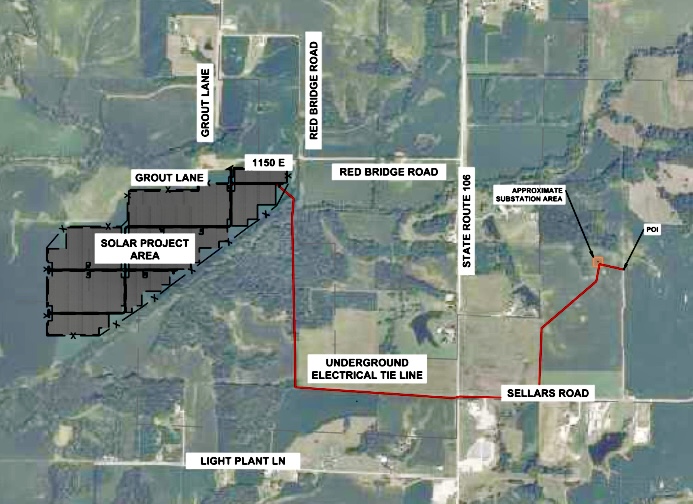
The proposed solar energy facility, spanning approximately 124 acres, would be located southwest of State Route 106 and Red Bridge Road, along Grout Lane and 1150 E. In addition to the solar panel arrays, the project would include an underground power line connecting the facility to an existing Ameren sub-transmission power line northeast of State Route 106 and Sellars Road. A small substation is also planned for the project on Parcel No. 09-03-100-008.
Koller Solar, LLC, based in St. Louis, Missouri, has filed the application for the project under Scott County’s Wind and Solar Energy Siting Regulations Ordinance (Ordinance No. 24-9). The company, wholly owned by BCD Project Holdings 3, LLC, plans for the solar panels to be mounted on arrays standing approximately ten feet tall within a fenced perimeter. The facility is expected to have a generation capacity of 20 megawatts.
The parcels involved in the project encompass various sections of Township Thirteen North, Range Twelve West of the Third Principal Meridian. These sections include locations for both the solar panel arrays and the underground power line infrastructure. According to the notice, the underground power line will run south and east from the solar facility, crossing State Route 106 and terminating northeast of State Route 106 and Sellars Road.
According to Koller Solar Director of Development Scott Novak, the site for the solar project was chosen by the company due to its topographic suitability and its vicinity to existing power infrastructure.
“Part of why we chose it is that it’s close to an Ameren line with capacity to take additional generation,” Novak said. “When we plan these projects we look for land in close proximity to those lines that have that capacity to take the additional generation.”
Novak attempted to allay resident fears regarding the negative aesthetic impact the project would have on the natural and agricultural landscape of Scott County – stating that there are no residents living in the immediate vicinity of the solar installation.
“In general this project is sited in such a way that it’s really not close to any residence,” Novak said. “There’s lots of natural vegetation in the landscape to provide screening.”
Another common criticism of rural solar projects is that they take farm ground out of production. Novak, again, attempted to reassure residents that the project is designed to not permanently alter the usability of the site for agricultural purposes in the future. Novak added that, while the expected lifespan of the solar installation is decades long, ultimately the site will be returned to its current agricultural appearance and use.
“The project is a temporary use,” Novak said. “It consists of steel posts driven into the ground, cabling, and glass panels. It’s designed to be a low-impact, temporary use – for up to 40 years. It’s not permanently displacing farm ground.”
Novak went on to explain that Koller Solar, as part of the state approval process for the project, is required to submit an Agricultural Impact Mitigation Agreement (AIMA) to the Illinois Department of Agriculture (IDOA).
“We’re required to develop for the state an AIMA, which is like a how-to manual of how to work with farm ground,” Novak said. “It addresses the treatment of topsoil, construction during wet conditions, and the decommissioning process. At the end of the project, the ground becomes farmable again.”
According to Novak, another reason critics should not be concerned with using agricultural land for solar projects, is that the amount of farmland that will likely be used statewide for solar projects is a small percentage of total farm ground.
“The amount of land needed to meet the goals of the state is just a percent of a percent of all agricultural land,” Novak said. “Less that 100,000 acres is needed to meet those goals.”
The power generated by the solar farm, Novak said, will likely not be used by local residents – but carried out of the area by Ameren’s transmission grid.
“The energy will likely be sold to a corporate customer, which is facilitated by Ameren,” Novak said.
Novak indicated that corporate customers are motivated to purchase power generated by solar and wind farms by renewable energy benchmarks, as well as price control.
“A lot of them have goals as far as how much of their power comes from renewable sources,” Novak said. “And they want more control over pricing. They can negotiate a price with us, whereby they have more control and predictability.”
According to Novak, the principal benefit of the solar farm to the residents of Scott County, is the amount of increased property tax revenue that will be generated by the solar installation.
“There are substantial tax benefits, and the majority of property taxes go to the school district,” Novak said. “It’s estimated to be $100,000 in year one.”
The Scott County Board will review the application in accordance with Illinois statutes, including 55 ILCS 5/5-12009.5 and the Illinois Open Meetings Act. The board’s evaluation will focus on whether to grant the requested Special Use for the solar energy facility.