Pike County Historical Society hosts presentation on planned Freedom Corridor
PROTECTED CONTENT
If you’re a current subscriber, log in below. If you would like to subscribe, please click the subscribe tab above.
Username and Password Help
Please enter your email and we will send you a password reset link.
By DAVID CAMPHOUSE

Submitted graphic
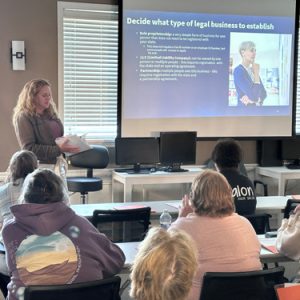
Last Wednesday, community members heard a presentation on a planned Freedom Corridor that would run from Springfield in the east to Quincy and Hannibal in the west. The presentation was hosted by the Pike County Historical Society at the Pittsfield United Methodist Church. The corridor would highlight the historic activities of freedom seekers and abolitionists that took place in the footprint of the corridor. The planned corridor would feature museums and historical sites, including Underground Railroad sites, in six existing communities in the region. In addition to the museums and sites in Springfield, Jacksonville, Pittsfield, Barry, Hannibal, and Quincy, the town site of New Philadelphia would also be central to the corridor.
Last Wednesday, community members heard a presentation on a planned Freedom Corridor that would run from Springfield in the east to Quincy and Hannibal in the west. The presentation was hosted by the Pike County Historical Society at the Pittsfield United Methodist Church.
The corridor would highlight the historic activities of freedom seekers and abolitionists that took place in the footprint of the corridor.
According to information from the National Park System and Contemporary Monuments to the Slave Past, “freedom seeker” is the preferred term that describes an enslaved person who took action to obtain freedom from slavery. According to the same sources, the term freedom seeker is preferred over other terms such as fugitive, runaway, or escapee, which imply criminality or dependency.
Freedom seekers were part of the Underground Railroad, a network of people and places that helped them escape.
The information on the Freedom Corridor was presented by Gerald McWorter and Kate Williams McWorter. Gerald McWorter is the great-great-grandson of New Philadelphia founder “Free” Frank McWorter.
In 1836, Frank McWorter established New Philadelphia, the first town legally founded, platted and registered by an African American in the United States.
The planned corridor would feature museums and historical sites, including Underground Railroad sites, in six existing communities in the region. In addition to the museums and sites in Springfield, Jacksonville, Pittsfield, Barry, Hannibal, and Quincy, the town site of New Philadelphia would also be central to the corridor.
According to Barry Museum Curator and New Philadelphia board member Marynel Corton, the corridor – by highlighting a larger region – would do much to bring attention to Pike County’s freedom seekers and its ties to the abolitionist movement. Corton also serves on Barry’s city council.
“Gerald McWorter has developed this idea of bringing several museums together between Springfield and Quincy to work together to showcase the history of the area,” Corton said.
“Since our museum was one of the first to host an exhibit on New Philadelphia, we intend to participate in the corridor.”
Likewise, the Pike County Historical Society’s Earl Pursley indicated that the Pike County History Museum would be included in the corridor.
“We need to get our museum ready,” Pursley said. “We open in May, but we could be open in April if it was warm enough.”
Corton and Pursley stated that McWorter is planning a meeting to help chart out the next steps of the Freedom Corridor, to be held at Illinois College in February. It is hoped that representatives from area museums, tourism groups, and educational institutions will attend the February meeting.
Also at last Wednesday’s presentation, Carolyn McCartney was recognized by the Pike County Historical Society for her years of hard work and volunteerism related to New Philadelphia and the Historical Society.
McCartney’s latest book, published last year, is titled Finding Home in New Philadelphia and Pike County, Illinois. The book is a collection of stories about New Philadelphia and the community in general.